Skip to master site navigation

In 1856 Bahá’u’lláh rejoined His family and the other Bábís in Baghdad. Under His renewed leadership, the stature of the Bábí community grew and His reputation as a spiritual leader spread throughout the region.

Bahá’u’lláh wrote some of His most renowned works in Baghdad, including the "Hidden Words," "Seven Valleys," and the "Book of Certitude" (Kitab-i-Iqan). His writings alluded to His station, but it was still not the time for a public announcement.

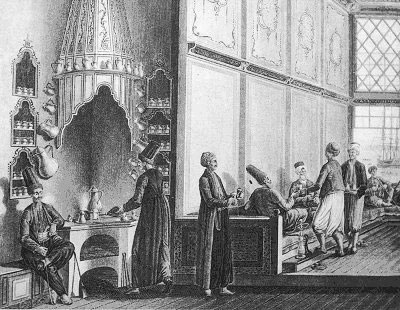
Coffeehouses in Baghdad provided places for theological and philosophical debate and inquiry. Bahá’u’lláh frequented such coffeehouses, and the refinement of His exposition and the beauty of His language attracted many people.

Photo 4 of 5: A 19th-century Ottoman coffeehouse.
General Information
The Bahá’í Faith
The international website of the Bahá'ís of the world.
The Life of Bahá’u’lláh
A photographic narrative about the life of the founder of the Bahá’í Faith.
Bahá’u’lláh
Writings of Bahá’u’lláh and a history of His life, His teachings, His station.
Attaining the Dynamics of Growth
Photographs of Bahá’í community life from around the world – devotional meetings, classes for children and youth, study of sacred scripture, service projects, and fellowship.
Reference
Bahá'í Reference Library
The Bahá'í sacred writings available online.
Bahá'í Statement Library
Statements issued by the United Nations office of the Bahá'í International Community.
Bahá'í Media Bank
Photographs available for downloading.
News
Bahá'í World News Service
News from around the globe.
One Country
The quarterly newsletter of the Bahá'í International Community, with in-depth features, book reviews and commentary.
Bahá'ís of Iran
News reports on the persecution of Bahá'ís by the government of Iran.
Bahá'ís of Egypt
Updates on human rights abuses suffered by Bahá'ís in Egypt.
Close
A 19th-century Ottoman coffeehouse.
A 19th-century Ottoman coffeehouse. (Engraving, c. 1800's)