Skip to master site navigation
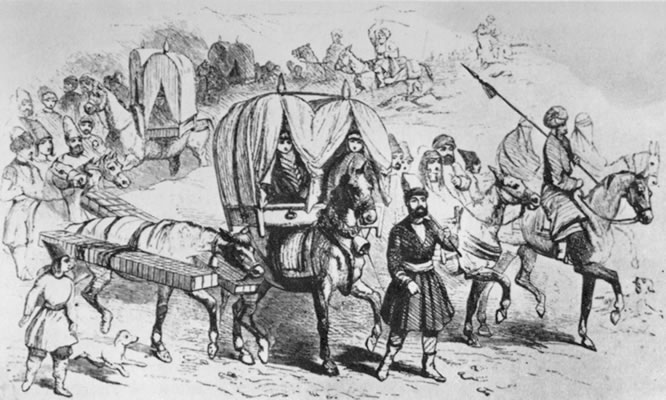
Drawing of a kajavih (howdah), a common mode of travel in Iran in the mid-1800s.

The journey to Constantinople

Bahá’u’lláh had become well-known in Baghdad and Kurdistan, and people came out to meet Him all along the way to Constantinople. Shoghi Effendi, the Guardian of the Bahá'í Faith from 1921 to 1957, writes in "God Passes By":

"The festivities which, at some stations, were held in His honor, the food the villagers prepared and brought for His acceptance, the eagerness which time and again they exhibited in providing the means for His comfort, recalled the reverence which the people of Baghdad had shown Him on so many occasions." (9)

Photo 1 of 4: Drawing of a kajavih (howdah), a common mode of travel in Iran in the mid-1800s.
Other Bahá'í Sites
General Information
The Bahá'ís
The home page of the Bahá'í International Community Web site.
Bahá'í Topics
Concise summaries of Bahá'í history and belief, and information about the worldwide Bahá'í community.
The Life of Bahá’u’lláh
A photographic narrative about the life of the founder of the Bahá’í Faith.
Bahá’u’lláh
Writings of Bahá’u’lláh and a history of His life, His teachings, His station.
Reference
Bahá'í Reference Library
The Bahá'í sacred writings available online.
Bahá'í Statement Library
Statements issued by the United Nations office of the Bahá'í International Community.
Bahá'í Media Bank
Photographs available for downloading.
News
Bahá'í World News Service
News from around the globe.
One Country
The quarterly newsletter of the Bahá'í International Community, with in-depth features, book reviews and commentary.
Bahá'ís of Iran
News reports on the persecution of Bahá'ís by the government of Iran.
Bahá'ís of Egypt
Updates on human rights abuses suffered by Bahá'ís in Egypt.
Close
Drawing of a kajavih (howdah), a common mode of travel in Iran in the mid-1800s.
Drawing of a kajavih (howdah), a common mode of travel in Iran in the mid-1800s. (Drawing, date unknown)